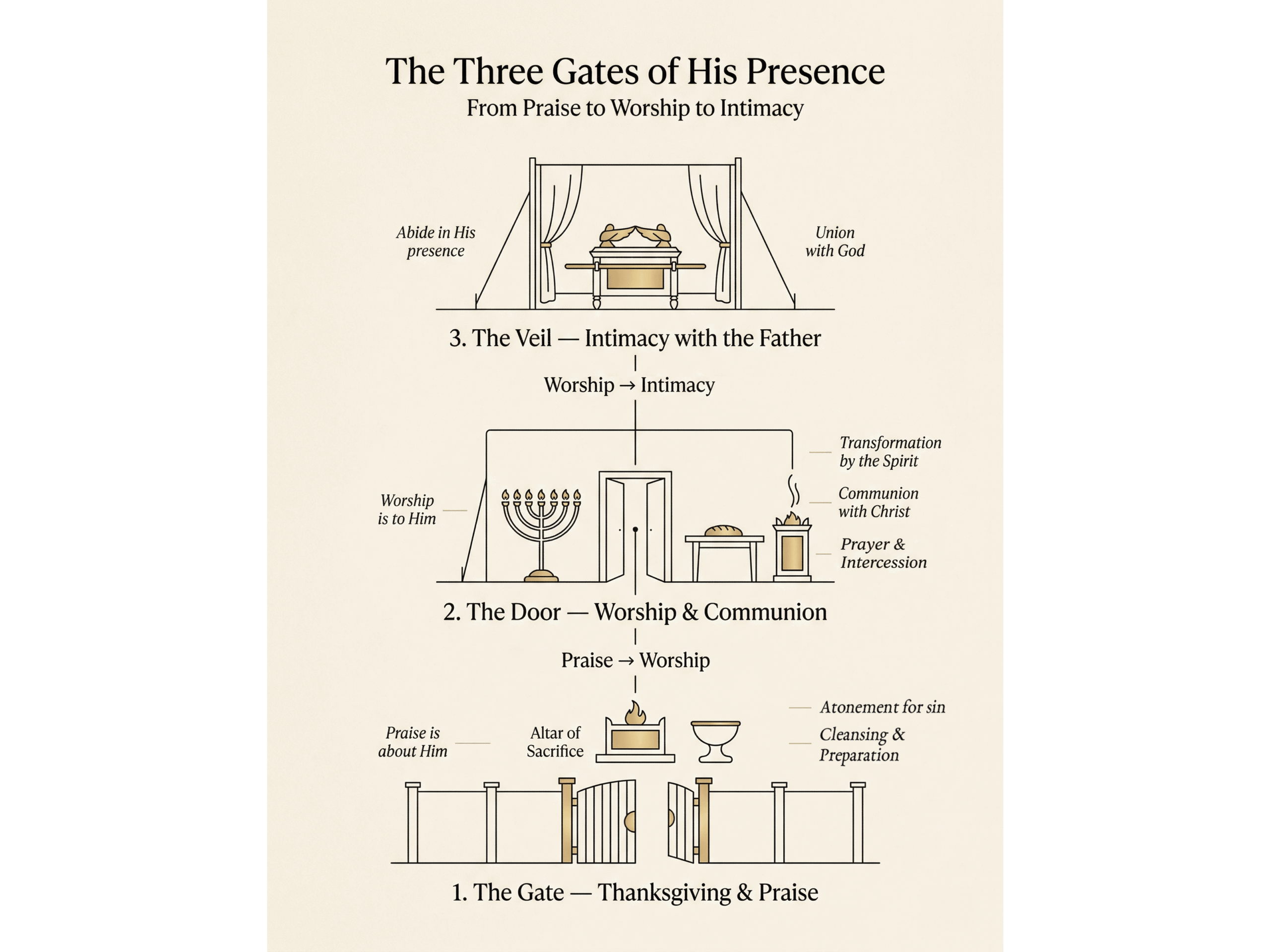
The Three Gates of His Presence
From Praise… to Worship… to Intimacy
“Praise isn’t optional—it’s the
key that unlocks the first gate to
God’s presence and power.”
— Jentezen Franklin, The Power of Short Prayers
I have been deeply impacted by Pastor Franklin’s latest book, and as I reflected on this insight, the Holy Spirit brought a familiar Scripture into sharper focus:
“Enter His gates with thanksgiving, and His courts with praise.” (Psalm 100:4)
In the Spirit, I saw a picture of the Tabernacle of Moses, but in a way I had never seen it before.
It was a divine pattern, a blueprint.
The Tabernacle reveals a progression in how God draws us closer to Himself: from outward expression to inward transformation, and ultimately into abiding intimacy with Him.
There are three distinct places, and three access points:
The Entrance Gate (Outer Court)
The Door (Holy Place)
The Veil (Most Holy Place)
Each one requires a key.
And together, they form a pathway.
Not merely a way to visit God, but a way to abide with Him.
1. The Gate — Thanksgiving & Praise
This is the first access point.
We do not enter God’s presence complaining.
We enter thanking.
We do not step in focused on ourselves.
We step in declaring who He is.
Praise is about Him:
His goodness,
His faithfulness,
His power.
This is also the place of the altar of sacrifice, where we lay down our lives.
“Present your bodies a living sacrifice…” (Romans 12:1)
Before we go deeper with God, something must be surrendered.
Praise is not just a song. It is an offering. It is the first key of approach. It is the beginning of repentance, thanksgiving, and reorientation. Here, we stop centering ourselves and begin centering Him.
This is also where many of us first encounter Christ.
We come aware of our need.
We come carrying burdens, sin, weakness, and often traces of orphan-mindedness.
And here, at the place of sacrifice, we receive mercy, forgiveness, and welcome.
Praise is where we encounter Christ.
It is the key that brings us through the gate.
The Outer Court — Salvation, but Not Completion
There is something we must understand about the outer court.
It is sacred.
It is necessary.
It is established by love.
“For God so loved the world that He gave His only begotten Son…” (John 3:16)
The outer court exists because of the sacrifice of God’s love.
This is where we first encounter Christ.
This is where:
- We confess
- We believe
- We receive salvation
It is the place of the brazen altar: the sacrifice.
It is the place of the laver: the washing.
The altar points to the Cross.
The laver points to water baptism.
This is where our spirit is made alive.
And this is a beautiful beginning.
But it is not the end.
A Sobering Reality
The first gate into His presence requires something profound…
but also something very simple.
It requires confession and belief.
Not maturity.
Not transformation.
Not even love.
This is why Jesus said:
“Come as you are.”
And that is the mercy of God.
But there is a tension we must not ignore:
If we stay as we are…
we resist the very purpose of salvation.
When Love Is Absent
It is possible to enter through a gate built by love…
and yet never be transformed by love.
The outer court does not require love for entry, activity, or even service.
This is where a sobering parallel emerges:
“Though I speak with the tongues of men and of angels, but have not love, I have become sounding brass or a clanging cymbal.” (1 Corinthians 13:1)
The outer court was filled with bronze instruments, sacrifice, and activity.
Noise. Movement. Function.
But deeper in…
It gets quiet.
Because intimacy requires listening.
The Danger of Remaining There
Many believers never move beyond the gate.
They are saved.
Their spirit is secure.
But their soul remains unformed.
They live their entire lives in the outer court,
with an emphasis on confession and belief…
but without transformation.
And something subtle begins to happen:
Lost and broken orphans
are discipled into becoming
high-functioning orphans.
They learn:
- Language without intimacy
- Activity without transformation
- Religion without abiding
They are present…
but not progressing.
The Progression — Faith, Hope, and Love
This is where a deeper pattern emerges.
The three spaces of the Tabernacle reflect a spiritual progression:
The Outer Court — Faith
We believe. We enter. We receive.
The Holy Place — Hope
We wait. We are transformed. We are formed.
The Most Holy Place — Love
We abide. We become one. We live in union.
“Now abide faith, hope, love, these three; but the greatest of these is love.” (1 Corinthians 13:13)
Faith gets you in.
Hope transforms you within.
Love brings you into union.
The Invitation Forward
The outer court is not the problem.
Remaining there is.
God did not save us only to forgive us…
He saved us to transform us.
He did not just make a way for us to enter His presence…
He made a way for us to abide in it.
2. The Door — Worship & Communion
Now we move from the outer court into the Holy Place.
Here, something shifts.
Praise is about Him.
Worship is to Him.
It is the difference between speaking about someone
and speaking with someone.
“Behold, I stand at the door and knock…” (Revelation 3:20)
When we open this door, we begin to commune with Christ.
This is where we encounter:
The lampstand — the sevenfold Spirit of God
The bread — His Word
The altar of incense — prayer and intercession
This is the place of inward formation. The Holy Spirit begins transforming us here, not just touching our emotions, but reshaping our nature.
This is where surrender deepens.
This is where communion becomes continual.
This is where we stop rushing and begin remaining.
And this is where another revelation comes into view:
Worship is where Christ lives in us.
He is no longer only the Christ we have encountered.
He becomes the Christ who dwells within.
His Spirit teaches us, sanctifies us, and even intercedes through us.
The bread reminds us that His Word must become our daily life.
The lampstand is not just revelation, it is the manifestation of the Seven Spirits of God.
The incense reminds us that true worship rises into prayer, intercession, and holy communion.
This is where we are prepared as the Bride.
3. The Veil — Intimacy with the Father
Beyond the veil is the Most Holy Place.
This is no longer about activity.
This is about abiding.
This is where the Ark is: His manifest presence.
“Let us draw near…” (Hebrews 10:22)
Through Jesus, the veil has been torn.
But intimacy is still entered intentionally.
At the gate, we encounter Christ.
At the door, Christ lives in us.
Beyond the veil, we discover the mystery of abiding in Christ.
Intimacy is where we abide in Christ.
This is the place of union.
The place of deep rest.
The place where striving gives way to oneness.
Here, it is no longer:
Just praise
Just worship
It becomes union.
This is where:
We are fully known
We are deeply transformed
We become like Him
This is the difference between Christ in us and us in Christ.
Christ in us speaks of indwelling life, transformation, and the Spirit’s work within.
Us in Christ speaks of abiding union, identity, security, and rest in Him.
Both are true.
Both are necessary.
But they are not the same.
The gate brings us to Him.
The door forms Him in us.
The veil reveals what it means to live hidden in Him.
The Pathway
This is why the Tabernacle matters.
It teaches us that God is not looking for a momentary experience, but a life of ongoing transformation. He is drawing us into a divine progression:
Praise — we encounter Christ
Worship — Christ lives in us
Intimacy — we abide in Christ
Or, to say it another way:
The Gate — approach
The Door — communion
The Veil — union
And again:
Outer Court — confession and belief (the way we enter) expressed through thanksgiving and surrender (the way we approach)
Holy Place — transformation and indwelling
Most Holy Place — abiding and intimacy
This is not a rigid formula. It is a revealed pattern.
It is the difference between:
Knowing about Him
Walking with Him
Becoming one with Him
The Invitation
Many believers remain at the gate.
They know how to praise,
but never step into worship.
Others enter the Holy Place,
but never learn to abide beyond the veil.
They want the voice,
without the surrender.
They want intimacy,
without the process.
But God is inviting us deeper.
Not into complication.
Not into religious performance.
But into closeness.
His yoke is easy.
His burden is light.
He has already done the heavy lifting through the Cross so that we can be close to Him.
That is why He made us:
to be close to Him.
The question is not whether He is willing to meet with us.
The question is whether we are willing to continue past the gate, through the door, and beyond the veil.
Spiritual Reflection
Where are you right now?
At the gate?
At the door?
Or at the veil?
Are you still learning to praise?
Are you growing in worship and communion?
Or is the Lord calling you into a deeper life of abiding?
Do not be discouraged.
Just take the next step.
Because He is speaking.
But we must remain positioned to hear Him.
We stay rooted in His presence by remaining rooted in His Word, through daily reading, meditation, and quiet time with Him.
The Word of God is not separate from His presence.
It is how He speaks, how He reveals Himself, and how He forms us.
The question is:
Are we positioned to hear Him?
Prayer — Take Me Deeper
Father,
Thank You that You have made a way for me to enter Your presence through the shed blood of Jesus, the only righteous Lamb.
Teach me to come through the gate with thanksgiving and praise.
Teach me to open the door and walk in true worship and communion.
And lead me beyond the veil into deep intimacy with You.
Holy Spirit, guide me from the outer court into the Holy Place,
and from the Holy Place into the Most Holy Place.
Let me not remain at the place of distance when You are calling me closer.
Teach me to encounter Christ,
to yield to Christ living in me,
and to abide fully in Christ.
Transform me, not just in what I say,
but in who I am.
In Jesus’ name, Amen.